Today is January 7th, 2026. I pulled up onto the Compound today as I’ve done literally hundreds of times over the past year, but today it hit different. Today I felt… close. I felt close to my Dad, to my grandfather, to the generations of builders that came before me in my family. Today when I pulled up to what we call Lot 4 or just “the shop” there was actual work going on.
I got out of the truck with Tango and it reminded me of opening the door for Tara the golden lab we had when I was a kid. I’d pull up on Dad’s job sites to work with him and it would just be me and the dog there some days. I almost looked around for him today. I’d like to think he’d be proud of what we’re doing here. It’s scary as hell. The cost and risk all this carries with it absolutely terrifies me some days into complete inaction, but today wasn’t one of those days.
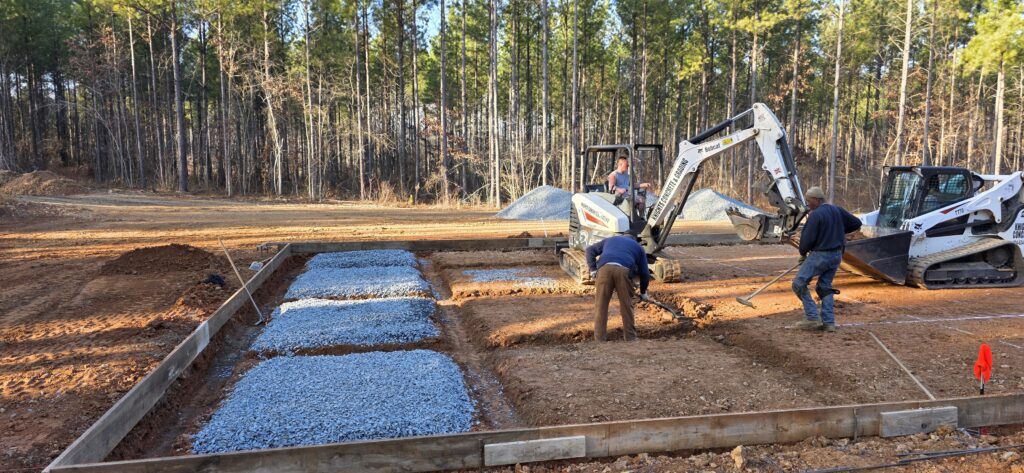
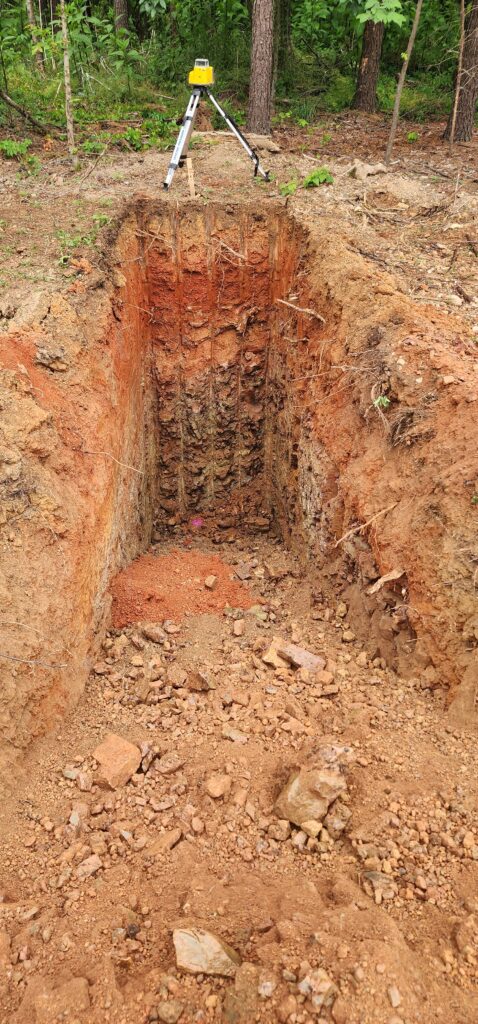
When I got to the site, Ron and Tony and their crew were digging out the footers for the shop. The plumber was there with his wife, Libby, setting the drain lines for the bathroom and prepping the RV dump station I plan to tie into my septic system.
After literally almost 12 months to the week, we’re finally done with earth moving, compacting, more moving, more grading, and the actual process of construction on the shop began in earnest.
This is also the first post I’ve made on the new website, so if you’re reading this, congratulations and welcome to “The Jordan Compound.” Amy has been writing articles these past few days and you’ll see some of them soon, but this is my little nook here on the website where I can share with you readers out there.
Pulling up on that site today and being the customer is a weird feeling. I was literally on job sites as a child from the moment I was old enough to swing a hammer. Dad and Papa had me out with them on jobs from about 8 years old. I’ve worked in various aspects of construction my entire career even though my core business is more technology related. Even with IT I’ve always found it comfortable to be wiring new buildings, renovating older structures, doing remodels and such. So many things come natural to me that I watch others struggle with, and I owe most of that to Dad and Papa.
When my guys struggle with laying out cabling in an existing commercial building, it doesn’t make sense to me because in my own head I’m looking at the foundation corner of the room, subtracting 1.5 inches, then eyeballing inwards in sixteen inch increments. I know that a floor tile is 12 inches so 1.25 tiles passes on the middle of the stud so 1.75 tiles inwards is an acceptable location for a penetration into a wall. If the floor is carpeted, I look to the ceiling instead and count ceiling tiles. All modern tiles are created on 2 ft by 2 ft increments, so two tiles equals three wall studs equals four feet. If it’s a hardtop I look for the telltale marks of drywall seams instead. Calculating footage and stud placement comes as natural to me as breathing. When calculating distance in an open beam ceiling I know that purlins are on 5 ft centers, so I can quickly look up and see three beams and know that the room is 20 ft wide.
But this project…. this one is totally mine. There’s no option to yell at the general contractor for messing something up. I know because I drew the plans myself that the general contractor is using to create his blueprints and we’ve spent countless days here at the old house over coffee designing, redesigning, editing, and tweaking plans. Even today when we were standing on-site I mentioned that we needed to be sure to remember the electrical conduits in the footers before they were poured. That prompted a conversation where David offered a suggestion that is truly just as efficient, doesn’t require it to be done during the footing pour, and would be cheaper in the long run. Man plans- God Laughs.
I’m the first to always say that no plan survives contact with the enemy. On a job site the enemy is the building itself. You can plan for absolutely everything you can imagine and the moment things start to get cemented into place is the moment you realize you forgot something or your calculation was off and it’s going to cause a problem.
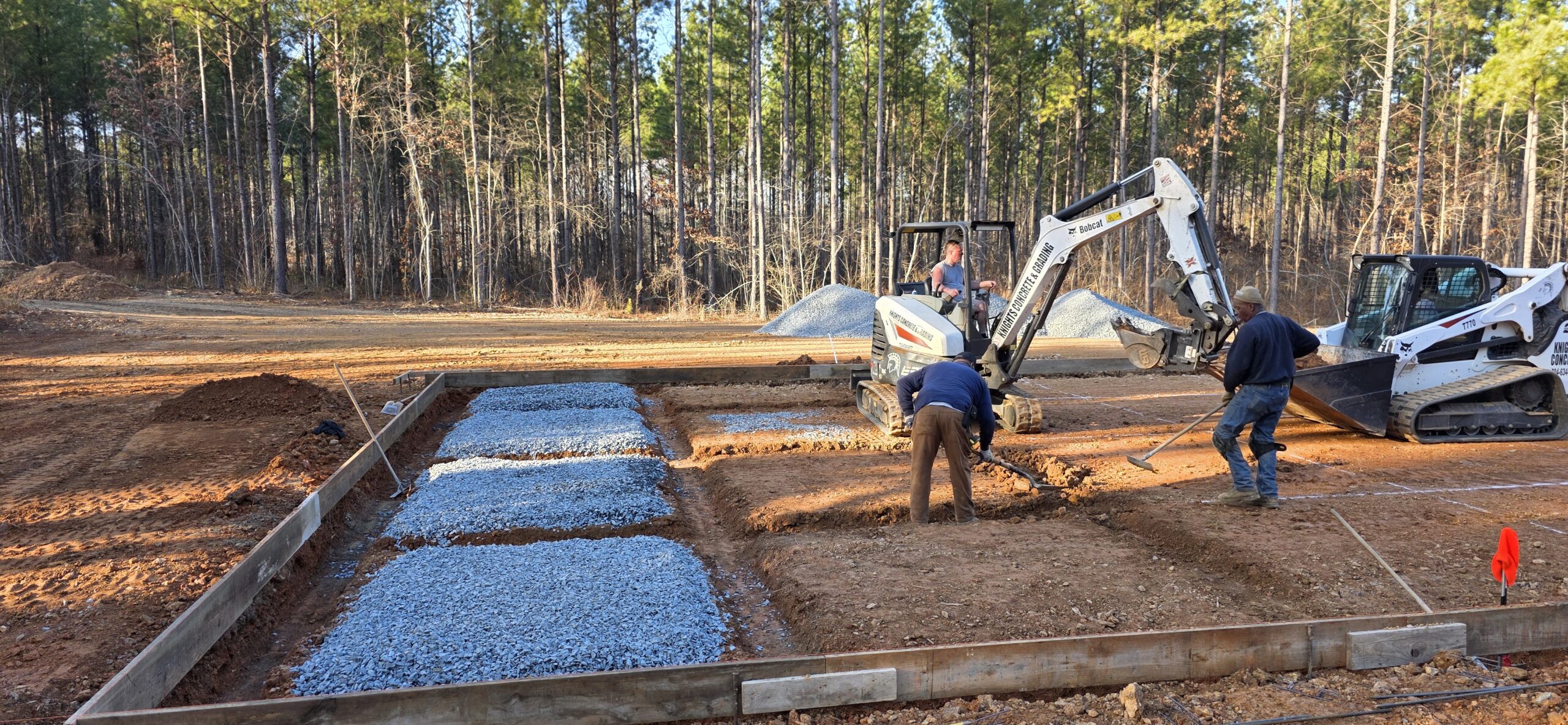
But today I didn’t have any of that on my mind. Today I watched Ron and Tony and those guys laying out the footer trenches, placing rebar and standoffs, and beginning the waffle slab cuts that will criss-cross the entire shop floor throughout.
In case the pic above looks strange to you I’ll explain.
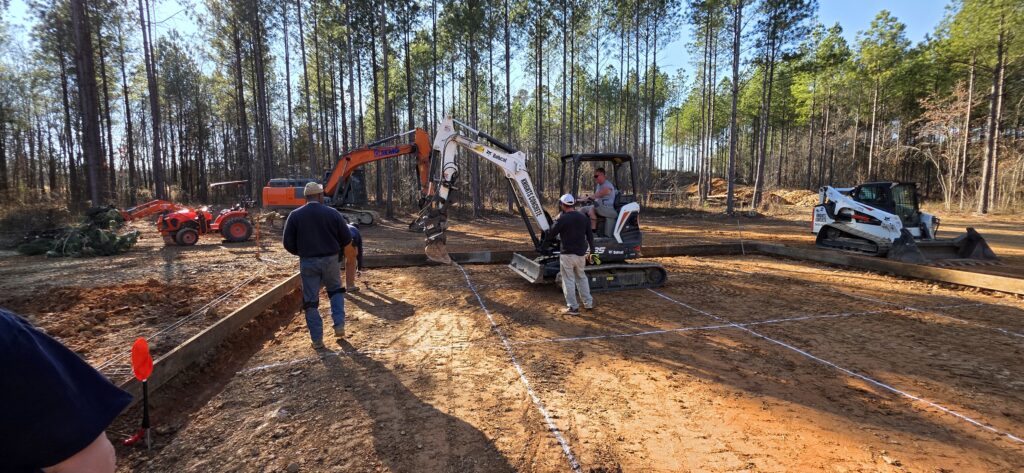
The boards you see going around the foundation are for the concrete forms to butt up against. The top of the board is the top height of the slab, so it’s currently about 12 inches above grade but we’ll raise the grade up as we get closer and it’ll be about 6 inches above grade when it’s complete most likely. That’s what I pay David for. He knows that kind of info so I don’t have to.
The concrete team measures out 10 foot lines and paints them on the ground and then Tony takes the excavator and cuts a six inch trench over the lines to create the waffle texture below the slab. Between the cuts, gravel is placed on the raised sections to get ready for concrete to pour over top.
Once the pouring begins, the concrete will settle into the rebar-reinforced waffle pattern under the entire floor of the shop. The purpose is to add strength. I’ve seen so many shops over the years suffer from cracked floors and that’s the one thing I told David I never wanted to deal with. One day I hope to build custom furniture in here, to have some 3D CNC routers in here, and the one thing you absolutely can NOT have is a cracked and gapped floor with uneven places.
This style of construction is a little more expensive but it’ll give me a solid foundation in the shop that will last my entire lifetime. What happens to it after I’m dead and gone isn’t my concern. If it lasts the next 40 years I’ll be perfectly happy with the added expense. (I mean I say that now, but I haven’t gotten Ron’s bill yet. Check back with me in a month or two. If you see me selling kidney fluid on the black market, just keep scrolling on by, ok? Don’t judge. A man’s gotta do what a man’s gotta do!)
Just to show you a little of the history, here are a few photos of the evolution of things.
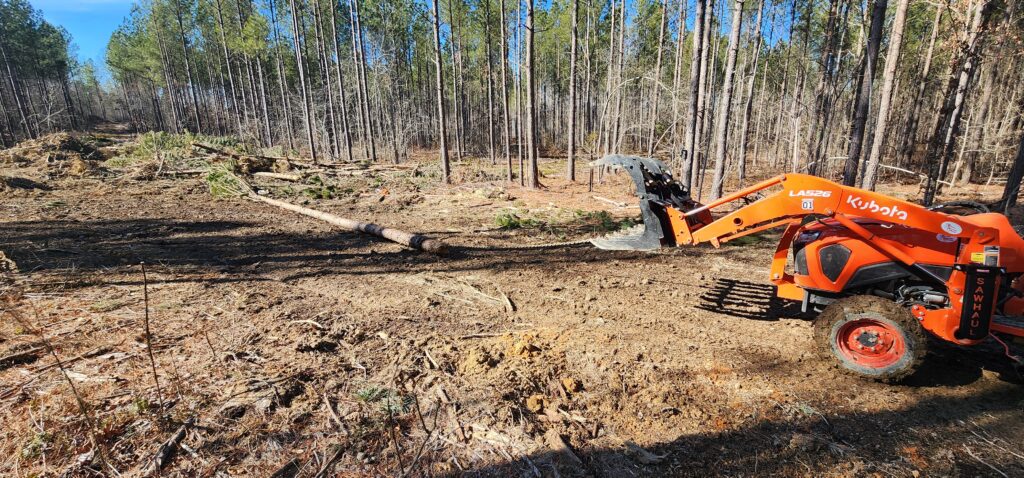
That photo above is January 25, 2025 – almost a year ago next week. Amy and I had spent a long few months taking down trees on each property to take out JUST the amount required. We individually checked and tagged every tree on this 40 acres that was to come down, just to make sure no one came in and started clearing land that would take a lifetime to bring back if they made a mistake.
It’s hard to even remember what it felt like back then. I remember my back hurt… I remember that much! Every tree in that clearing that came down was cut into 12 ft sections, and then we stacked the tops and burned them off. God the amount of fires we built when we were starting.
I was SO terrified of accidentally setting the woods on fire that my first slash piles were four feet high, 8 feet long, and maybe 6 feet wide. After weeks and weeks of burning and getting more comfortable knowing what the humidity would do, how the wind acts in certain areas, and just being exhausted I found myself lighting off slash piles 200 feet long, 10 feet wide and 12 feet tall and just letting it burn! Don’t get me wrong. I still have a huge respect for mother nature and what she can do, but after burning basically the equivalent of 6-8 acres by hand, tree by individual tree, I’m pretty comfortable now knowing my limitations.
I’ll never forget the memories I’ve had the chance to make with Amy during all this either. Never in our strangest dreams did either of us see her driving a tractor on our “farm” property while I ran a chainsaw. To borrow a phrase from common usage these days – I didn’t have that on my bingo card!
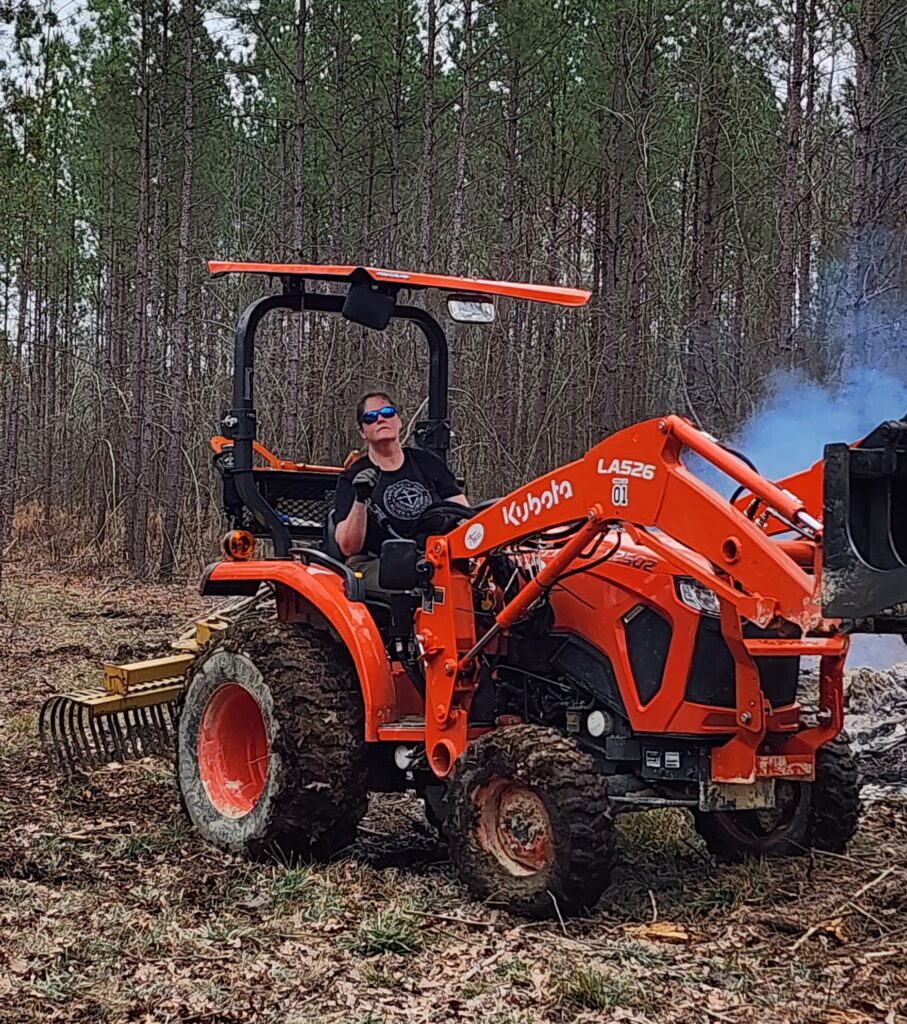
She thinks I’m camera crazy. I’m always snapping photos of her doing things, especially when it’s stuff she’s doing with me.
It’s not that I’m a shutterbug. It’s that I want to be able to share the memory one day. My kids don’t have an interest in this kind of thing right now. I didn’t either when I was their age. But as an adult all I have is the stories Mom tells me occasionally of how she and Dad built our first house, and how she helped do this or that.
I want more than the stories to look back on. I want to break out the (digital) photo album when we’re 70 and throw back to the days when Momma-Amy was a badass on the tractor hauling logs out from the shop and the house while I was out there cutting them down and logging them.
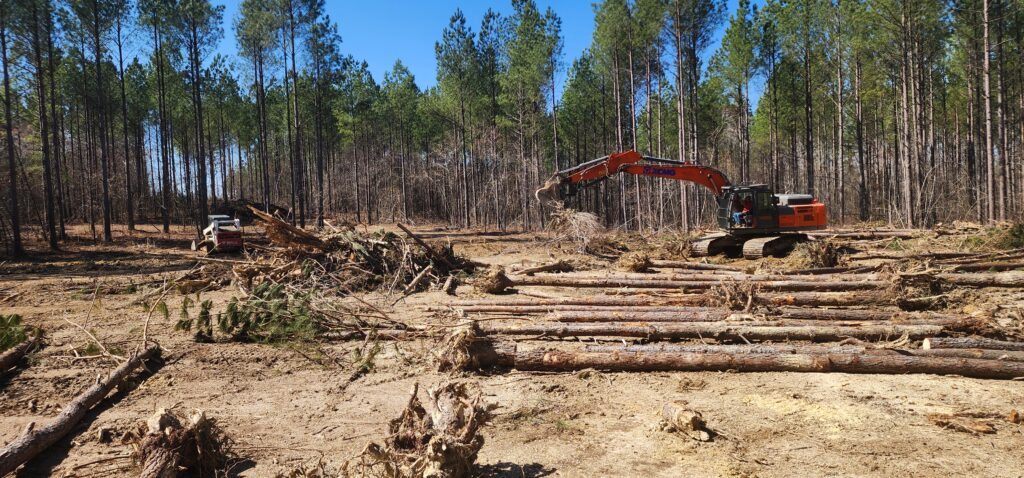
This photo above was March. We’d been clearing and cutting and burning for two months at this point and it was still a minefield of downed pines that we couldn’t navigate. The only way through it was to just keep logging, cutting, and burning.
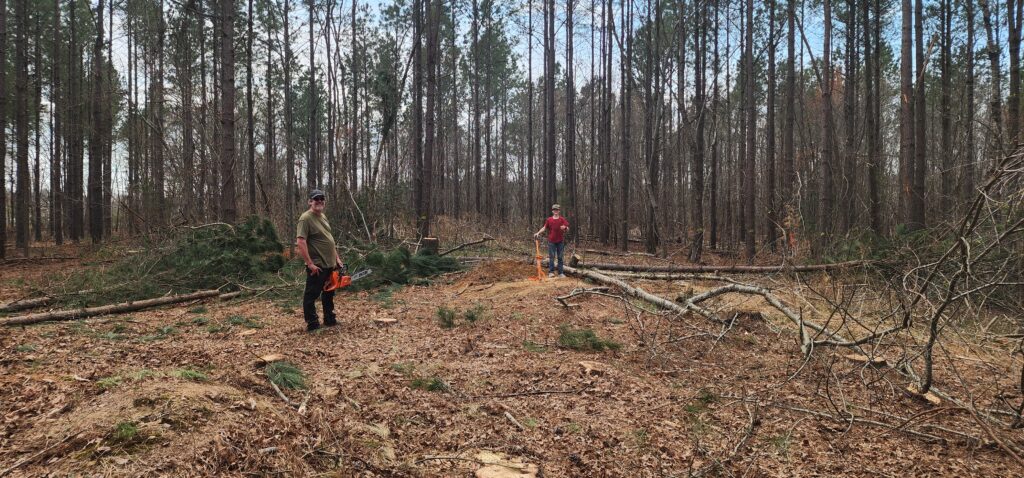
I’ve made some great memories with friends and my team too along the way. Kemp is one of my team at Twisted Networx. They enjoyed coming out to help. I got to teach Trevor how to use timber jack while Kemp took turns with me trading off from the tractor to the chainsaw.
Not having help can be it’s own blessing sometimes. When you’re working solo you can take all the time you need, but the going is slow. It’s a constant repetition of cutting for about 15 minutes, then going back to tractor to move what you’ve cut so you can move forward to work the next section.
Having help on the other hand more than doubles the speed at which you can work because no one has to stop working. But… umm.. I’m getting older and swinging that 20 pound chainsaw ain’t as much fun when you’re not stopping every 15 minutes to run the tractor for awhile. So Kemp would trade off with me every hour or so. One of us would cut for a bit and then we’d swap and that one could drive the tractor for an hour or so to give them a break.
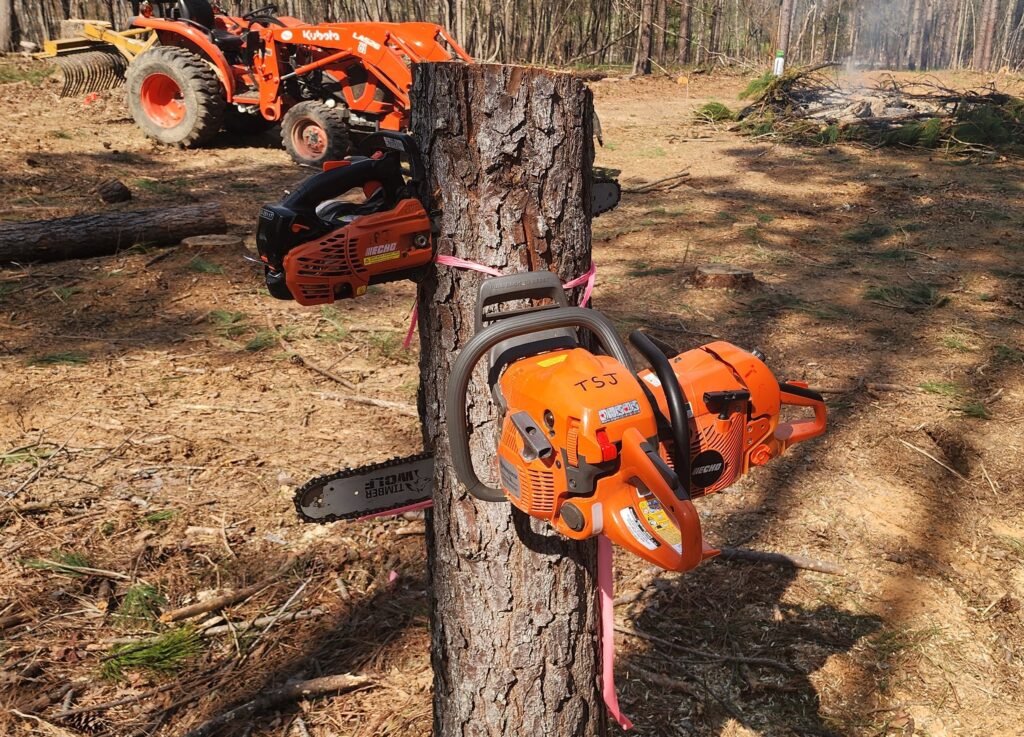
And let’s not forget the simple expense of the tools it takes to do this kind of work. If you’d asked me four years ago if I’d ever own farm equipment I’d have told you it wasn’t very likely, but it didn’t take long for my pragmatic mind to start evaluating options.
Rental costs of equipment and the cost of paying operators for certain things quickly add up when you’re talking about 40 acres of working farmland. I could either spend the same money and have the work done faster, but have nothing to show for it when it’s done, or I could buy my own equipment, buy my own tools, do the work myself and when the project is completed I’ve collected both the equipment to continue using to maintain the land, to use for other work-related projects, AND I’ve gained hundreds of not thousands of hours operating it all.
In case you’re curious, it breaks down like this:
Large Equipment
A good mid-size tractor. The General is a 25 horse Kubota L2502 with a dual piston grapple, bucket, loader, commercial bush-hog, and a variety of other implements I’ve picked up from friends on loan. That’s about $36,000
Roscoe, the Honda Pioneer 700, I purchased second hand from an older lady whose husband passed away. It was about $11k, but I ended up putting another 1K into it because I didn’t know they weren’t the FIRST owners of it. Apparently the FIRST owners were some kids that decided it would be fun to mud bog with and I had to learn how to rebuild an entire front differential and change CV joints.
Chainsaws
I remember purchasing my first gas powered chainsaw to help with a hurricane effort on the Outer Banks back in… maybe 2015, or 2016. It was purchased from Tractor Supply in Albemarle for $236 and I thought that was a big toy and it cost a lot. I had no idea!
Thankfully, I was in a much better financial situation when Hurricane Helene hit western NC in late 2024. After crewing and leading a ridiculous number of chainsaw crews during the relief effort I got to see first hand what goes into maintaining a good saw, what kind of saw does what kind of work best, and what kind of saws to stay away from.
Personally I settled on an Echo Timberwolf for my main heavy saw. She’s 20 inches long and 65cc and cuts hardwood like a hot knife through butter – as long as you keep the chain out of the dirt. That saw is about $700 after you get chains, gas, oil, etc.
A friend of mine, Ben, donated me a 20 inch Husqvarna 450 rancher that didn’t work at the time. It had all kinds of problems and I never thought it was going to be worth anything, but Ben sat there in the rain on the tailgate of my truck during Hurricane Helene and literally tore that saw down, fixed the variety of things wrong with it, and managed to put it back together and it fired up. I decided to give it a shot and while it’s not quite the badass my Timberwolf if, it’s a great saw!
Having two big saws is a huge bonus. The Rancher is a little cheaper and so are the chains for it, so it’s what I call my “ground” saw.
Fun fact: Most people already know that running your chainsaw through dirt and debris will quickly ruin its sharpness. It literally takes about 1 second or 1 rock to make a chainsaw completely useless until the chain is resharpened. What people might NOT know is this: Cutting trees near the ground, even if it looks clean, isn't clean at all. Pine trees expecially are known for their bark absorbing the dirt and clay that accumulates near the base of the tree. It makes total sense when you think about it. If it's constantly surrounded by dirt and rocks, it only makes sense that some of them get picked up inside the base of the tree. So when you're cutting at ground level, you're cutting through trace amounts of dirt and soil the entire time.
So the Rancher is the ground saw. This is the one that cuts the trees at the base so my Timberwolf stays super sharp. Once the tree is down on the ground, I’ll cut it up with the Timberwolf. So that’s two saws you have to carry around with you.
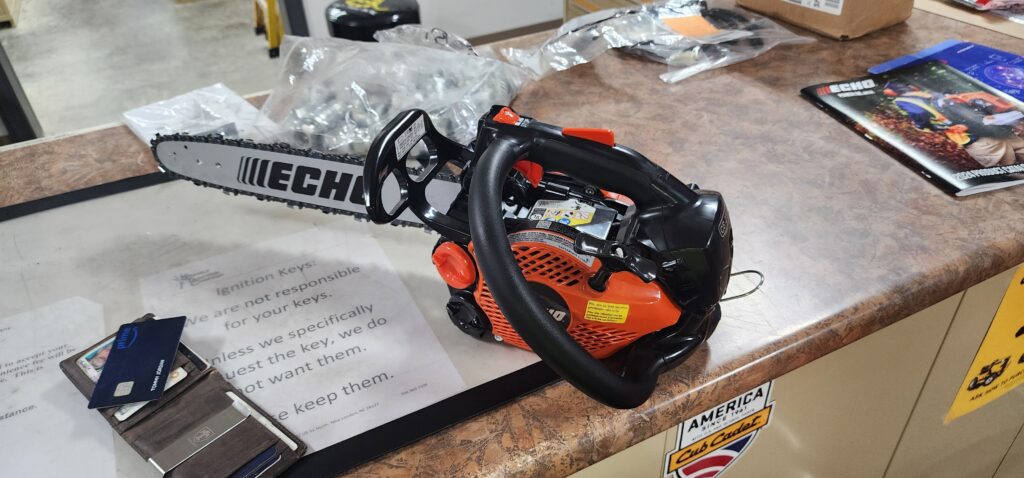
So we’ve cut the trees down and cut up the big stuff, but what about all those limbs and small branches that need to be trimmed?
Limbing out a tree with a 20+ pound saw after you’ve already been logging for 4-6 hours is a defeating task. Your arms are already beyond the point of being worn out and the act of swinging that big saw on that much small stuff is just painful to even think about.
This is where Penelope comes in! Yes, we named the Echo CS-2511T Penelope because it’s small and cute.
But dont for one second let that fool you. This saw is by far my favorite saw of all of them. It took the guy at Stanly Tractor quite a few minutes to convince me that I was going to spend more on that saw than I did on the BIG saw. This little saw is almost $700 by the time you get it kitted out and ready to rock and roll.
I originally bought it for Amy to do limbing with. She actually gave me a hard time, telling me “Don’t you dare go buy me a girly saw.”
It took her a bit to understand that there’s nothing girly about this saw. It literally cuts limbs, branches, and small trees as fast you can wield it. Cutting something like a 1 inch sapling is like swinging a machete at it. By the time the chain touches the wood, it’s through and never even slowed down. Taking down 4 inch trees takes about 3 seconds. This thing is awesome.
I’ve somehow gone down a rabbit hole of tools… let me digress back to my point.
I forgot my point… I think the first picture of the chainsaw sent my ADHD into overdrive….
Oh yeah, working on the land!
Let’s not forget all the time consuming (and kinda expensive) stuff that goes along with trying to clear all this yourself safely and without burning the woods down.
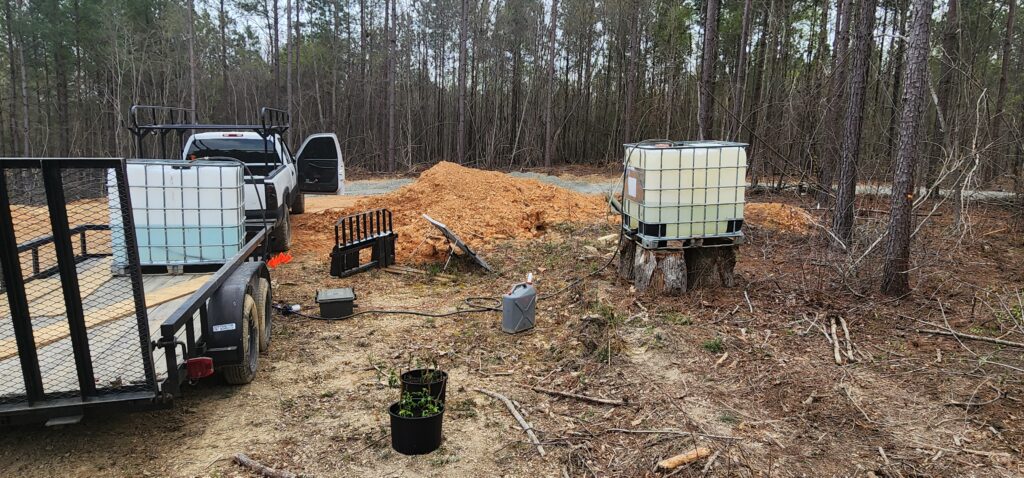
We’ve got 40 acres to work, maybe 10 acres total to clear out, and we’ve got no power, no running water, and no access to either resource.
That got me on the hunt for some IBC containers. That’s the name of those things you see above. They are 275 gallon containers that hold a variety of liquids. These here came from a friend. The school purchased them during Covid and they were full of hand sanitizer. I got them for the low low price of free.99.
After taking them home and cleaning them out with soap and water, they were ready to use for fire-fighting or for watering plants until the buildings got built. I didn’t need them for that right away, but Amy’s desire for planting things was always going to outpace my contractor’s ability to work quickly. That was never in doubt!
The next challenge? How do you move 275 gallons of water easily?
The answer is you don’t. Water weighs 8 pounds per gallon, so a full container is 2,200 pounds, or just over 1 ton. The container weighs 135 pounds empty, so now you’re at 2,335 pounds.
No small farm tractor has that kind of lift capacity in the bucket. (Yeah, add that to the list of things I wish I’d known when I was pricing tractors, right?) But to be fair NONE of the smaller tractors can pick up that much weight on the front. You’d need a BIG boss to get that kind of lift on the front end.
So I had to come up with a way to ferry water. One of the IBCs sat at the property in proximity to the current areas we were burning. The other would ride on the trailer back to the house, get filled with the garden hose, and then I’d bring it back out to the property and pray I could park close enough to rig up a water transfer system.
Well, neither physics nor gravity wanted to cooperate with me. In order to have any real pressure at all, the IBC needs to be fairly full and in order for water to flow, it needs to flow down hill. Water won’t move uphill on it’s own without serious pressure.
Thankfully my buddy Tim Pendergrass is a bigger geek than I am!
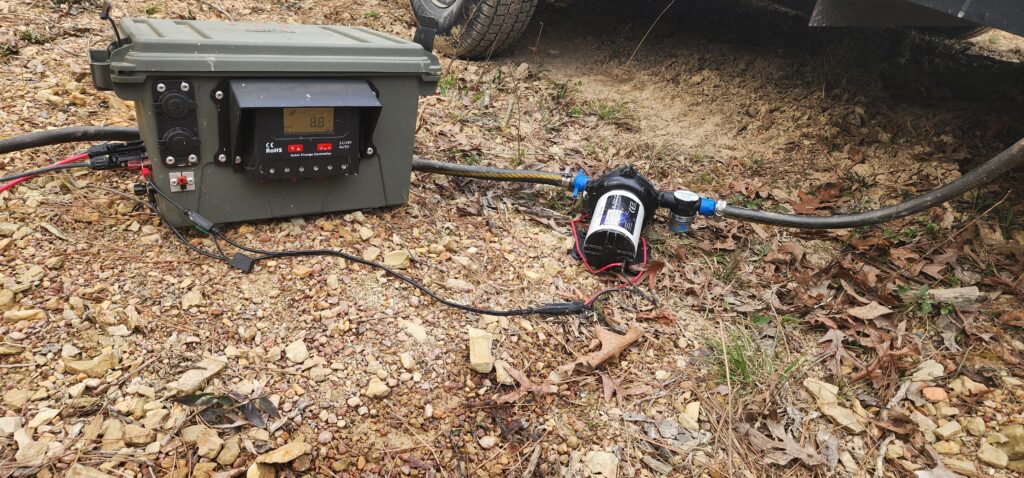
The box you see above is a custom box Tim built for himself and then after deciding he needed a bigger one, he gave me this one. It had been sitting in my shop for months with no real purpose to serve yet…..
It’s basically a box of 18650 batteries he reconditioned, added a charge controller and some outlets and connectors to, and the rigged to a solar panel input for recharging.
So this little box ran my Harbor Freight RV pump enough for me to transfer the IBCs back and forth. It’s not quick mind you…. it takes over an hour for this little pump to move that much water, but in the end it worked and that’s what matters.
Everything about this…. project? I’m not sure project is even the right word. Everything about this undertaking has been a challenge. That’s not a complaint. I truly enjoy challenges. They teach me how to overcome obstacles I’ve not faced before.
Building this shop, this house, and working this land has taught me a lot of things about myself, and about my Dad and grandfather.
I finally realized that I looked at them the same way people that don’t know me but see what I do look at me. I often hear “I don’t how how you learn all this stuff.” It finally clicked that when I was a kid and thought my Dad knew literally EVERYTHING… that he didn’t. He was figuring it out as he went just like I’ve been doing. This was just one of those experiences that gave me so many back-to-back challenges that I had to overcome that I just quit worrying about challenges in general. They’re just challenges, and I’ll just figure it out as I need to.
It’s really translated to a lot more peace in my work-life too. My team still gets flustered, pissed off, aggravated at job sites when things don’t go right. I used to be the same way. The last solid YEAR of non-stop challenges has taught me that I’ll figure it out. That’s what humans do. None of us have all the answers. We LOOK like we have all the answers to someone on the outside I suppose, but really we don’t. We just take one challenge at a time, solve it, and move on.
Have all my solutions been perfect? Oh absolutely not. You guys don’t see the failures. You only see me post the successes.
There are days I go to the compound and I’m there for 5-6 hours. During that time I might only “work” for one and a half hours, but that’s because I spent the other four trying to figure out how I was going to overcome some obstacle, or I was sitting and thinking about how to do the most work and achieve the most progress, with the limited resources (just myself). What can I do TODAY that’s going to help me tomorrow? Or what does the contractor, the grader, my wife, the county permitting office, or someone else need that’s on a timetable that has to be done by a certain date to avoid holding up some other step.
Bringing it all back around.
I say all that to say that when I got out of my truck today and set foot on what was finally a “real job site” I was ready for it. Do I know how it’s all going to come together? Not yet. Do I know where the well is going to be, what guage wire I need for the 400 amp service to the building, how I’m going to get power to the gun range, or any of the other hundred questions I’m going to have to figure out in the coming months? Nope.
But neither did Dad and he was TRULY a MASTER craftsman. I’ve got his same confidence. Anyone that knows me can vouch that I’ve never suffered from a shortage in that department. But it’s not confidence in my SKILL that makes me at peace these days. Instead its confidence bred from hundreds or thousands of small challenges that have all been overcome that lets me know I’ll come up with the answer when I need to. I don’t know it now, but I’m confident I can figure it out when needed. THAT is the lesson that building this farm, this compound has taught me.
In the last year and a half we’ve taken on building a new home, building a new shop, setting up the guest house property as a business that can rent/VRBO for additional income, started keeping bees, planned for fruit trees and sales of wildflowers to local nurseries.
In case you’re curious, I don’t know how to do ANY of that… yet.
But I married the strongest, most capable woman I’ve ever known and she just simply will not let me fail. She comforts me when I need it, but more importantly she just exists in this space in my mind and in my heart that means I simply can not allow her dreams to not come true. Failing her isn’t an option. Sure, I want some “me” things (like my shop) but for the most part she’s the reason for all of this – and with THAT as the reason, failure isn’t an option.
And maybe I just needed to say that out loud (as it were)…. You, the reader, don’t get it I’m sure, but I’ve been struggling with a lot of fear lately about this whole endeavor. The magnitude and the sheer cost alone are staggering to a guy that grew up in a single-wide trailer. But I just realized… this is almost completely for HER… so it can’t possibly fail. She’s never failed at anything in her life and I’m certainly NOT going to allow myself to fail to deliver her dreams when they’re finally on the horizon.
And in case I ever doubt that… I’ll leave myself with this picture as a reminder…
She has a tractor, knows how to dig a hole, and knows how to dispose of a body…